
Background Check by name and date of birth delivers fast, reliable results for anyone needing to verify identity, locate previous addresses, or uncover criminal history. Users can perform a background check search, background records lookup, or background screening through the official Greenville County portal, which aggregates court filings, arrest logs, property records, and marriage documents. The service answers common questions such as how to run a background check, what information a background record shows, and why some records may be sealed.
Background Check tools also support background check by address, by state, and by county, helping employers, landlords, and private investigators find accurate public records quickly. By entering full name, date of birth, and known aliases, you can conduct a background records search, verify identity, and retrieve court case outcomes, driving records, and professional license data. The platform respects privacy rules, requires consent where needed, and guides users on correcting inaccurate or missing files.
How to Search Background Check
A background check search by name and date of birth helps you compare public records with the correct person. Start with the Greenville County Sheriff’s Office for arrest and inmate records, then use the agency that holds each court, property, marriage, driving, or license file. You can also access county auditor to review official records. A full legal name, date of birth, and prior names support accurate identity matching. No single search covers every record type, so a complete review often requires several official sources.
Official Search Portal: https://gcso.org/
Steps to Search
- Open the Greenville County Sheriff’s Office portal at https://gcso.org/. Use the site menu or search field for terms such as “records,” “inmate search,” or “public records request.” Menu labels can change, so choose the option that matches the type of file you need.
- Select the record type before entering names. Use an inmate or arrest lookup for people held or booked by the Sheriff’s Office. Use the records request process for incident reports, release records, or other law enforcement files handled by GCSO.
- Enter the person’s full legal name and date of birth. Add a middle name, suffix, maiden name, or former name when the source requests it. An exact date of birth helps separate people who share the same name.
- Set the jurisdiction to Greenville County for local events. Add other South Carolina counties or states when the person lived, worked, or faced charges in those places. Use the county where an event occurred rather than only the person’s current county.
- Review the date range, case status, and record type before running the search. Remove narrow filters if the first result returns nothing. Active, closed, dismissed, and historical cases may sit in separate indexes or court systems.
- Compare each match using the full name, date of birth, event date, county, case number, and charge or case type. Do not treat a common-name match as the same person without several matching fields.
- Save the result page, receipt, or request number. A reference number can help the records unit locate the same file if you need certified copies, correction records, or follow-up details.
- Check other official sources for record types outside GCSO custody. Court, property, marriage, business, driving, and professional records come from their own record holders.
Background Record Search
A background record search works best when you begin with the type of event rather than a broad collection of names. GCSO records can confirm an arrest, booking, custody event, or incident report. County and state court records can show filed charges, hearings, case outcomes, and civil judgments. Separate offices hold deeds, business filings, marriage records, driver records, and professional licenses.
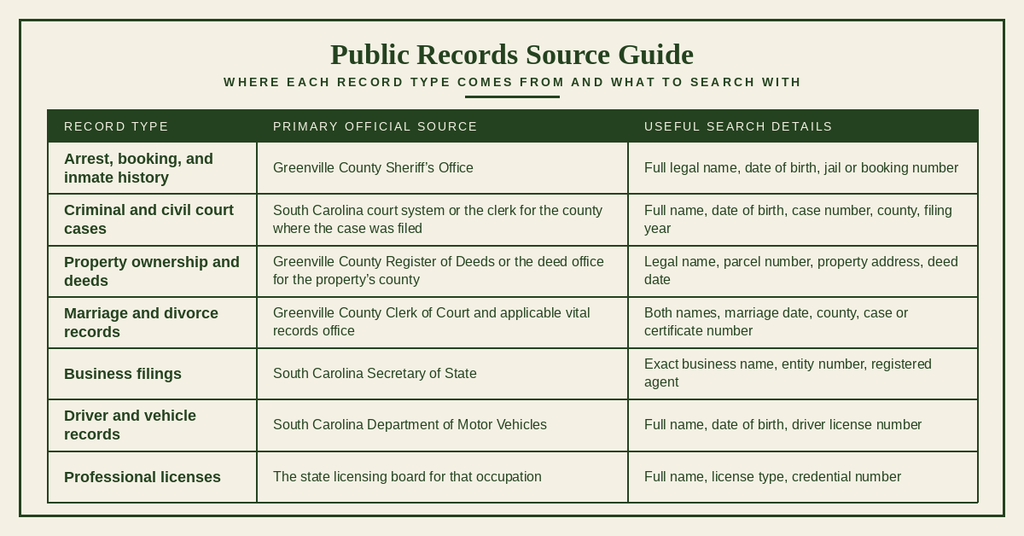
For a background check by name, date of birth, and address, the address serves as a supporting field rather than proof that a person lived there. Owners, tenants, family members, and former occupants may share one address. For a background check by state or county, search every place connected to the event, since a current address does not reveal where an arrest or court case occurred.
Identity matching works on more than a name. A reliable comparison uses birth date, aliases, address history, case number, event date, and county. If two records conflict, keep them separate until the issuing agency confirms the match. That practice prevents one person’s case from being attached to another person with a similar name.
Public search results usually show a limited set of fields, such as a case number, party name, filing date, court, status, and last court action. Some systems omit birth dates, full addresses, documents, or closed-case details. A blank field can mean that the record is restricted, that the source does not publish that field, or that the data has not yet reached the search system.
Criminal, Court and Public Record Data
Criminal and civil records answer different questions. A law enforcement file may show that an arrest occurred, while a court file shows the filed charge and later case action. Property and marriage files come from other offices and should never be treated as proof of a criminal case.
Arrest Logs and Offense Filings
An arrest record documents a booking or detention event. It does not by itself prove that a crime occurred, that the arrest was valid, or that the person was convicted. The related court docket may show whether charges were filed, dismissed, amended, or decided after the arrest.
Use the GCSO portal for local arrest or inmate history. For a suspected case elsewhere, contact the sheriff’s office in the county where the arrest occurred. After locating an arrest, search the court index for that county using the person’s name and birth date. A case number from the court result can then replace a broad name search.
Arrest data may carry a lag between the event and its appearance online. Data vendors also receive refreshed files on their own schedules. For a current employment or legal decision, ask the agency for a direct status when the online entry appears old or lacks a disposition.
Misdemeanors, Felonies and Sentences
Misdemeanor and felony labels describe the offense filed in court. They do not decide the final outcome. A dismissal, acquittal, deferred sentence, plea, conviction, or sentence appears through separate docket events, so each stage needs review.
A court file may list charges such as driving violations, theft, assault, fraud, or other offenses, along with the court, case number, filing date, hearing dates, plea, sentence, fine, probation, incarceration, and restitution. Exact fields depend on the court and the type of case.
Search by charge name alone can create false matches. A person’s name, birth date, county, and case number give a much stronger basis for comparison. Once you have the case number, use it to review later filings and confirm whether the case remains open or has reached a final disposition.
A criminal history check may also cover federal cases and offenses committed in other states. Federal criminal history normally requires an authorized fingerprint-based request, and out-of-state court records sit with the court where the case was filed. One Greenville County search cannot cover those records.
Civil Dockets and Judgment Orders
Civil dockets cover disputes that do not begin with a criminal arrest. Common examples include contract claims, property disputes, landlord and tenant cases, family matters, money judgments, and small claims. The docket may show the parties, case number, judge, hearing schedule, pleadings, and final judgment.
A filed case is not the same as a judgment. A claim may be dismissed, settled, or decided after a hearing. Judgment records can also appear in county lien indexes after a money award. Search both the case docket and any related judgment or lien record for the correct county.
Civil records can carry privacy protections for minors, victims, trade secrets, sealed filings, or matters removed from public access. A clerk can explain whether a file needs a case-specific request, a fee, or a court order. Do not assume that every document attached to a civil case is public.
Property, Business and Marriage Filings
Property records show deed transfers, parcel details, liens, and recorded ownership. They do not prove that a named person currently lives at the address. Use the Register of Deeds for the county where the property sits, and search by parcel number when it is known.
Business filings belong to the South Carolina Secretary of State. An entity search can reveal a company’s registered name, formation date, standing status, filings, and registered agent. A registered agent may be a service company rather than an owner, so the filing itself may not identify the person who controls the business.
Marriage and divorce records are handled through the county clerk and applicable vital records systems. A marriage record may confirm names and the event date, but certified copies may require an application, fee, identification, or proof of eligibility. Property ownership, business registration, and marriage are separate events and should not be merged into one criminal-history conclusion.
Legal Compliance and Consumer Rights
Public records can support personal verification, employment review, housing review, legal work, and other permitted uses. The legal duties change with the method used, the purpose of the search, and the type of record requested. A direct public-record request is not always subject to the same federal consumer-report rules as a paid third-party screening report.
Permissible Use and Screening Laws
The federal Fair Credit Reporting Act, or FCRA, applies to consumer reports used for employment, housing, credit, insurance, and other covered purposes. Under 15 U.S.C. § 1681b, an employer must disclose its use of a consumer report and obtain written permission before the report is ordered. The employer must also meet the adverse-action process in 15 U.S.C. § 1681a(q) before taking action based on the report.
A public-record search can still raise FCRA, employment, privacy, discrimination, and state or local law concerns. A screening vendor that assembles and regularly supplies consumer reports may be subject to FCRA requirements even when much of the source data comes from public records. Legal review should confirm the process before an employer acts on a result.
Driving records receive added treatment under the federal Fair and Equitable Transactions Act and South Carolina driver’s record law. Professional and court records may carry court-specific access rules. Use each record for the purpose allowed by its source, and never use a record search for harassment, retaliation, or a decision based on protected traits.
For an employment decision, the employer should keep the report, written permission, job-related criteria, and any dispute correspondence. If the applicant asks about an inaccurate entry, direct the dispute to the reporting company or the agency that supplied the record.
Mandatory Applicant Consent Rules
Written applicant consent is required when an employer uses a consumer report covered by FCRA. The disclosure must state that a consumer report will be requested and explain the business purpose. The applicant’s signature must authorize that request. A résumé, job application, or request for “any records” may not meet the consent requirement by itself.
Do not reuse an old authorization for a later employer or a new purpose. If a company uses its own staff rather than a consumer reporting company, FCRA may not govern every part of the review, yet other privacy and fair-employment rules still apply. South Carolina law and any applicable local rules should be checked for the specific screening program.
For a personal background check on another person, written permission is a sound practice even when public access exists. Permission confirms that the person consented to the search and provides a record of the purpose. It does not remove the need to follow record-specific access rules.
Official Record Correction Rights
An inaccurate search result and an inaccurate government file are not always the same problem. A third-party report may contain a stale copy, a duplicate, or a mismatched person. Individuals can also check vin lookup to verify relevant details. An official file may contain a clerical error that requires correction by the court or records custodian.
Under 15 U.S.C. § 1681i, a consumer reporting company must reinvestigate a disputed item free of charge within 30 days of receiving the dispute from the consumer. It must review relevant records and remove or correct information that is inaccurate, incomplete, or cannot be verified. The consumer may dispute the item with the furnisher, the reporting company, or both.
Official corrections follow the record holder’s process. Contact the court clerk for a case entry or disposition, GCSO for an arrest or incident entry, the Register of Deeds for a deed, the Secretary of State for a business filing, SCDMV for a driver record, and the licensing board for a professional credential. Include a case number, supporting document, and the exact field that needs review.
A request for correction should state the factual error rather than demand deletion without cause. Examples include a wrong birth date, misspelled name, duplicate case, incorrect charge, or entry linked to the wrong person. Keep a copy of the request and any agency response.
Public Availability and Official Copies
An online search result and an official file serve different purposes. A search result helps locate records and narrow the next step. An official copy may carry a custodian’s certification, accepted signature, seal, or statement about the record’s status.
Requesting Official Agency Copies
Use the current request form or portal published by the agency that holds the file. A complete request usually includes the record holder’s full name, date of birth, case or reference number, record type, event date, county, requester contact details, and a clear description of the documents needed.
Provide only the identifiers needed to locate the file. A full Social Security number is seldom necessary for a court or property request, and sending it through an unverified form creates needless risk. If the agency requires identity proof or signed permission, use its official upload method.
Fees vary by record type and agency. South Carolina public-record requests may include document charges plus an administrative fee, and certified copies may cost more than standard copies. Check the agency’s current fee schedule before submitting a request. Do not rely on an old price shown in a search result or third-party page.
GCSO may use a public-records request process for law enforcement records outside its public search pages. State court filings usually come from the court’s case search, with document copies requested from the clerk. County offices may use separate systems for deeds, vital records, and other documents.
Certified File Documentation
A certified copy confirms that a document was produced from the record holder’s official file. It may include a seal, signature, title, or certification language. A third-party background report can support initial review, but it does not replace a certified record when a court, agency, employer, or licensing board asks for one.
Before ordering, ask the receiving party which certification it accepts. Some agencies accept a clerk’s copy without a raised seal, while others require a full certified document. Requesting the correct format at the start can prevent delays and duplicate fees.
Sealed, Expunged and Juvenile Exclusions
Sealed records are not open to ordinary public searches. Access may be limited to the parties, attorneys, courts, law enforcement, or others named by statute or court order. South Carolina’s Public Records Act and its law enforcement exceptions also limit release of some investigatory files. A clerk or records custodian must decide whether a specific file can be opened.
Expungement is a legal process that closes and seals eligible records under South Carolina law. An expunged case should not appear as an ordinary open case, yet an old index entry or retained arrest data can remain visible. Give the court the expungement order and ask for the current status rather than treating the old entry as a current conviction.
Juvenile records have separate protections and limited public access. An adult’s background review should not treat a sealed juvenile matter as an open case. Access requests must follow juvenile-record law, and an agency may need to redact or withhold protected material even from a person who has another adult record.
No result does not prove that no arrest, case, or conviction exists. It may mean the file is sealed, expunged, outside the searched county, still under indexing delay, or stored under a different name. Use an official status request when the missing event has legal or employment consequences.
Record Accuracy and Resolution
Background check accuracy depends on the source, the search date, and the quality of identity matching. A clean result means that the searched source returned no visible match for the identifiers used. It does not certify that the person has no record anywhere.
Differentiating Similar Name Matches
Common names can produce dozens of matches, and one misspelled birth date can exclude the correct file. Start with the full legal name and date of birth, then compare county, event date, and case type. Prior names, former addresses, and known record numbers can resolve a shared-name result.
Never merge two records merely because their names look alike. A proper match has several consistent fields and no major conflict. Conflicting birth dates, sex, addresses, or event locations need agency confirmation before they are treated as the same person.
- Confirm the full legal name, including middle names and suffixes.
- Compare the date of birth exactly with the source record.
- Match the county and event date to the location where the event occurred.
- Use a case number, jail number, parcel number, or license number as the final identifier.
- Keep unrelated matches in separate result lists.
A search by address can narrow candidates, but it can also create false associations. Property owners, renters, former tenants, and authorized users may appear at the same location. Confirm each person’s connection through the record that lists the event.
Multi-Jurisdiction Reporting Delay
Records update at different speeds across Greenville County, other South Carolina counties, other states, and federal systems. A clerk may post a judgment after a case database refreshes. An arrest may reach a vendor later than the court docket. Expungement orders and name corrections can take extra time to clear from every copy.
A current result should show a “last updated” date or source date where available. If the most recent event is missing, contact the agency that created the event and ask for its current status. This is more reliable than relying on a third-party page that refreshes on a fixed schedule.
Use separate searches for each relevant county and state. South Carolina court records do not contain every case filed elsewhere, and a federal criminal case does not appear in a county civil docket. A full review may require county records, out-of-state court searches, SCDMV data, professional boards, and an authorized federal history request.
Do not count arrest charges from one court as final results if a later disposition is missing. Read the full event sequence through the last recorded action. A pending case, dismissal, acquittal, conviction, and sentence carry different meanings, so each stage should be stated separately.
Unlisted Background File Resolution
If a background check returns no records, first repeat the search with the full legal name, exact birth date, and fewer filters. Clear date ranges, case-status filters, and jurisdiction limits that may have removed the file. Search former names and spelling variants when the person has used them for legal documents.
Next, search the court index directly in the county where the event may have occurred. Arrest data and court filings can use different names, and an event at the county level may sit in a neighboring jurisdiction. A jail booking number or case number can lead to the missing file.
Ask the relevant office for a record status if a known event remains absent. Include the approximate date, location, charge or case type, and identifiers so staff can search archived indexes. For an incident report, request the GCSO records unit. For a court entry, contact the clerk. For driving data, use SCDMV’s permitted request process.
If a report shows an error but the official file is correct, send a written dispute to the reporting company under FCRA. Include the report name, page, entry, disputed fact, and supporting record. A corrected report should be requested before the result is used for an employment or legal decision.
Keep a final review sheet that lists every source searched, the date searched, the identifiers used, the case or record numbers found, and any pending request. This creates a clear record of the search and prevents a later assumption that an unsearched source produced “no records.”
Contact Details
Contact the Greenville County Sheriff’s Office for questions about its records, inmate search, or public-record request process.
- Location: 4 McGee Street, Greenville, SC 29601
- Phone: (864) 271-5210
- Office hours: Monday through Friday, 8:30 AM to 5:00 PM
Frequently Asked Questions
Find quick answers to common questions about background checks in Greenville, SC, and how to locate public records.
How to run a background check in Greenville SC?
Start at the Greenville County Sheriff’s Office website or visit their office at 4 McGee Street. Request arrest and inmate records using a full legal name and date of birth. For court, property, or marriage files, contact the specific agency that holds each record. Provide any known name variations and previous addresses to improve matching. Some records require a fee and may need a signed consent form. Multiple agency searches often give the most complete picture of a person’s background.
What information does a background check show?
A background check can reveal criminal charges, court case outcomes, and sentencing details. It also includes driving records, license status, and traffic violations. Public records such as property ownership, marriage or divorce filings, and business affiliations may appear. Address history and previous names help confirm identity. Certain restricted data, like sealed or expunged items, are usually omitted unless a court order allows access. The exact mix of data depends on the agencies queried and the purpose of the search.
Can sealed records appear in a background check?
Generally, sealed or expunged records do not show up in standard public searches. Courts order sealing to keep the information private, and most agencies honor that restriction. However, law‑enforcement databases may still contain the data for internal use. If a job or licensing agency has a legal reason, they might request a special court order to view sealed items. For most personal or employment checks, you will not see sealed records unless the requesting party has proper authorization.
How to search background records by name and DOB?
Enter the exact full name and date of birth into the Greenville County Sheriff’s online portal or request a manual lookup at the office. Include any known aliases or maiden names to broaden the search. Verify the spelling and use the correct format for the date. The system cross‑references these details with arrest, court, and inmate files. If the first search returns many matches, narrow results by adding a prior address or middle name. This approach reduces mismatches and improves confidence in the returned records.
Why might a background check return no results?
No results can occur if the person has never been arrested, charged, or involved in a public court case. It may also happen when records are sealed, expunged, or still being processed. Incorrect or incomplete personal data, such as a misspelled name or wrong birth date, will prevent matches. Some agencies require a fee or signed consent before releasing information, and without those, the search will be empty. Double‑check the input details and consider contacting each relevant agency for confirmation.